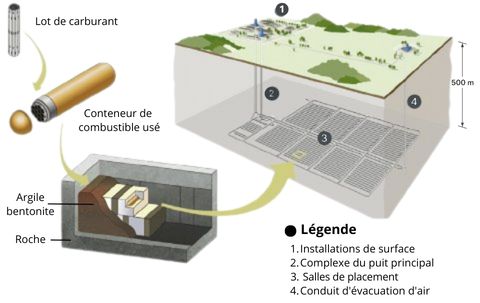
The Nuclear Waste Management Organization (NWMO) is responsible for the long term management of nuclear waste produced by Canadian nuclear power plants. In partnership with the Government of Canada, it developed Adaptive Phased Management (APM). This comprehensive approach covers the entire used fuel cycle, from initial storage to final disposal in the Wabigoon Lake Ojibway Nation and Ignace area.
For more than a decade, Novika has been working with the NWMO to design and optimize processes that are essential to this disposal system, which is intended to protect future generations for the next two hundred thousand years.
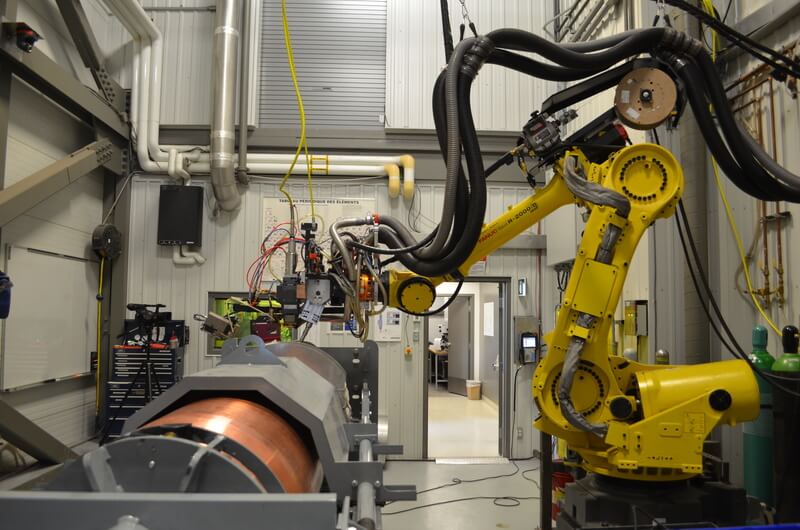
Novika collaborated with the NWMO for several years on the development of this system, notably by developing the laser welding procedure used to seal the used nuclear fuel container. The Novika team also designed the mobile equipment used to move and compact the granular bentonite corresponding to barrier number 4. However, this barrier requires a minimum compaction of 1.41 g/cm³ to ensure its effectiveness.
The NWMO commissioned Novika to design a sensor capable of characterizing the density of granular bentonite.
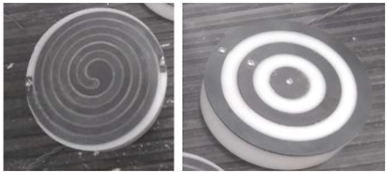
For a material with a known moisture content, an effective way to identify this level of compaction is to use a capacitive moisture sensor. Novika’s team therefore first carried out electromagnetic simulations in order to select two promising designs. The first focused on optimizing the electrical capacitance value, while the second offered a compromise between magnetic field penetration and electrical capacitance.
The test results demonstrated good repeatability over a wide measurement range, while also providing a robust, user friendly solution. These two sensors therefore represent an efficient solution for measuring the density of a high volume granular material, such as the one used in the system that will ensure the safe storage of Canada’s nuclear waste.